" /> Jewish Labor Committee: August 2019 Archives

« July 2019 | Main | September 2019 »

August 30, 2019

This Labor Day, Jews Must Recommit To Workers' Rights

by Ari Fertig

August 29, 2019 - Boston, MA: The fight for working people -- for labor and against income inequality -- is picking up steam.

Workers' voices are being heard. Organized labor unions in the transportation sector are standing up. Teachers unions are being revitalized. Non-traditional walkouts at places like Google or Wayfair are increasingly common. Both the right and the left have strong populist movements and feel the need to appeal to working class voters.

If you keep your eyes open, the trend is clear. Now is the time for a revitalized labor movement -- and Jews have to be a part of it. If Jews are to be true to their values, history, and law, then we must support labor rights for all.

To be true to ourselves, we have to remember where we came from. We must remember our Jewish history. In the mid-19th century, when many Jews started to arrive in the United States, most were workers. From the very beginning of the labor movement in America, Jews have played a pivotal role, be they in the garment industry, or in professions like cigar makers, bakers, printers, painters, or actors, or in labor leadership such as Samuel Gompers, a Jewish founder of the American Federation of Labor. The Forward was originally founded as a Yiddish-language daily socialist newspaper, and newspapers like these were critical to building the class consciousness of the Jewish people. The roots of the American-Jewish experience is tied to the fight for a better life--the fight for labor rights.
NE JLC FB wall image from April 2017 4 web.jpg

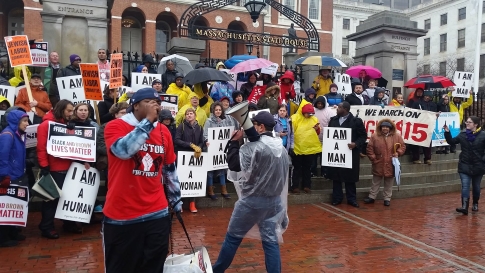
New England JLC activists and over 100 fast food, airport and other low-wage workers, and a wide range of community partners, joined in a march to the Massachusetts State House on April 4, 2017, to commemorate the 49th anniversary of the assassination of Martin Luther King, Jr., and to support the ultimately successful campaign for higher wages, specifically the Fight for $15 bill in the legislature would raise the minimum wage to $15 an hour, and for racial and economic equality.

Today, over half of U.S. Jews view working for justice and equality as essential to being Jewish; that's more than how many say caring about Israel is essential to being Jewish.

The logic is clear: If economic justice is a core plank of social justice, and social justice is critical to being Jewish, then Jews must get involved with the fight for economic justice.

Still, it's not just a matter of the values of Tikkun Olam and social justice. It's also a matter of Jewish law. Halacha, Jewish law, has many clear instances of siding with workers, from the right to prompt payment, to the right to stopping work at any time, limiting hours of work and giving the benefit of the doubt to workers in disputes over wages, to setting aside part of the fields for the hungry and the stranger. More specifically we are commanded, "You shall not oppress a hired servant who is poor and needy, whether he be of your brothers, or of foreigners who are in your land within your gates." (Deuteronomy 24:14).

But what about modern Jews who do not follow Halacha, who might not be familiar with the history of the Jews in the labor movement, and who may care about social justice, but don't gravitate towards doing that work through a Jewish lens? I would argue that for all Jews there is an imperative to take the fight for working people and against income inequality seriously.

Jews must understand this moment. It is no coincidence that as income inequality has risen, so too has the number of hate crimes committed against minorities, including Jews.

It is during times of economic turmoil and anxiety when people start looking for others to blame for their lot in life. Research shows that places with higher income inequality have a tendency to also have higher rates of hate crimes and hate incidents. One way anti-Semitism operates is by redirecting economic frustrations and blaming Jews, re-creating the age old fantasy that Jews "secretly" control the economy.

Jews have to care about making an economy that works for everyone because that's the only way Jews can not only be economically secure, but secure in our lives as well.

There are ways to re-engage with the fight for working families. Support your local unions. Join your chapter of the Jewish Labor Committee. Make sure your synagogue's social action committee includes economic justice as part of their mission. But ultimately, whatever way you get involved, it's time, this Labor Day, for the Jewish community to renew its ties to the labor movement.

Ari Fertig is the Executive Director of the New England Jewish Labor Committee.
August 28, 2019

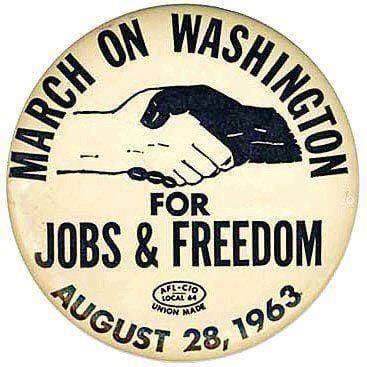
56 Years after the March on Washington for Jobs and Freedom

by Stuart Appelbaum

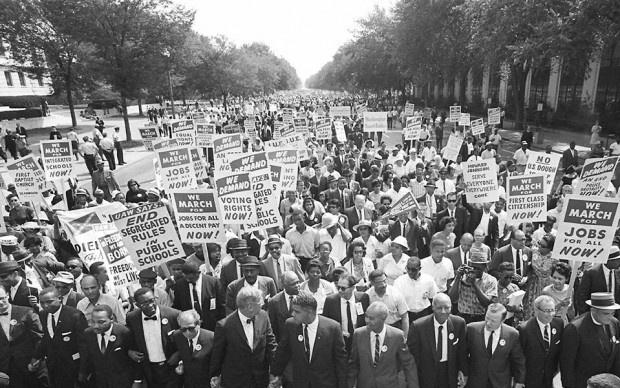
On August 28, 1963, more than 200,000 Americans gathered at the Lincoln Memorial in Washington, D.C., for a political rally known as the "March on Washington for Jobs and Freedom."

Under the leadership of A. Philip Randolph and with the civil rights leader Bayard Rustin as its principal organizer, this march, organized by a broad coalition of civil rights, labor, and religious groups, was one of the largest political demonstrations for human rights in the history of United States. It was designed to put the political, economic, and social discrimination suffered by African Americans squarely on the national agenda. The massive turnout, the dignity and discipline of its nonviolent plea for justice, and the grandeur of Martin Luther King, Jr.'s "I Have a Dream" speech made it a key moment in the long struggle for civil rights. Part of its legacy was passage of the Civil Rights Act of 1964 and the Voting Rights Act of 1965.

Of the many Jewish organizations that participated in the March, none brought more people to the event that day than the Jewish Labor Committee.

https://image.pbs.org/poster_images/assets/mlk.jpg
Image from The Unfinished Business of the March on Washington and the Civil Rights Movement Lesson Plan

From New York City alone, the JLC filled two railroad cars. From Philadelphia, a large contingent came in buses that were jointly chartered by the JLC and the Negro Trade Union Leadership Council. The two organizations had completely coordinated all of their March on Washington plans.

Other JLC groups came by cars, trains and planes from Baltimore, Boston, Pittsburgh, Detroit, Chicago, Minneapolis and the West Coast. All of the JLC's field officers were actively involved in promoting the March and worked with local March committees in their communities. JLC Executive director Emanuel "Manny" Muravchik, served as an advisor to civil rights activist and March coordinator, Bayard Rustin, and was instrumental in helping to mobilize the Jewish community. According to Rachelle Horowitz, who worked closely with Rustin to organize the March and was its transportation coordinator, Muravchik reached out to the leadership of major Jewish organizations to involve them in the March, and was Rustin's "eyes and ears" in the Jewish community.

The JLC's commitment to civil rights didn't begin in 1963. In the late 1940s, it began working to set up "Committees to Combat Intolerance" in cities throughout the U.S. and Canada. It investigated labor practices in the South and protested employment discrimination in Northern cities as well. For many years, it held annual civil rights conferences for labor activists. JLCers marched at Selma, Alabama and again in Memphis.

As we and others honor the 1963 March on Washington on this anniversary, we recall with great pride the role the JLC played in this historic event, and the many contributions the JLC has made to combat manifestations of bigotry, prejudice and discrimination and to support civil rights legislation.
---
Stuart Appelbaum is President of the Jewish Labor Committee and President of the Retail, Wholesale and Department Store Union, UFCW.

March on Washington for Jobs and Freedon August 28 1963.jpg

August 16, 2019

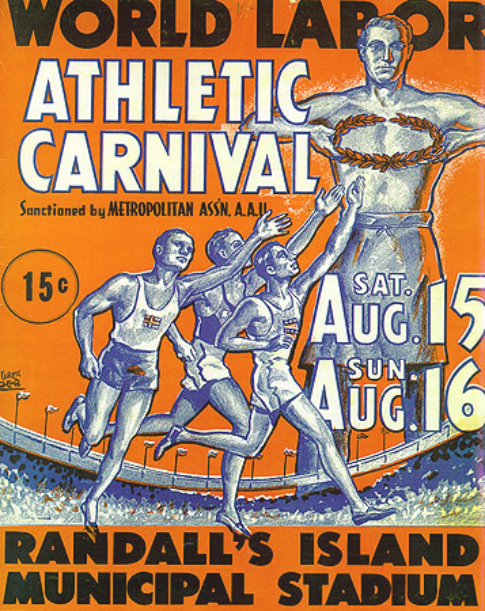
1936: Anti-Nazi World Labor Athletic Carnival Held in New York City

1936 NYC World Labor Athletic Carnival.jpg
(Jewish Labor Committee collection, Robert F. Wagner Labor Archives / Tamiment Library, New York University)

August 16, 2019 - New York, NY: We mark the anniversary of the World Labor Athletic Carnival, held on August 15th and 16th at New York's Randall's Island, to protest the holding of the 1936 Olympics in Nazi Germany. The two-day event, organized by the Jewish Labor Committee with the active support and cooperation of a number of unions and labor bodies, brought over 400 athletes from across the United States to compete in what became known as the "Counter-Olympics." Honorary co-chairs of the event included New York Governor Herbert Lehman, NYC Mayor Fiorello LaGuardia, American Federation of Labor President William Green and Judge Jeremiah Mahoney, former President of the Amateur Athletics Union of the United States and a leader of the "Move the Olympics" movement, who resigned from the American Olympic Committee to protest holding of the 1936 Olympics in Berlin. Chairing the Labor Committee of the Carnival was Isidore Nagler, Vice President of the International Ladies' Garment Workers' Union.

The story of this little-known episode in labor history begins in late 1934, when the newly-formed Jewish Labor Committee (JLC) learned about plans to hold the 1936 in Berlin. Early in 1935, JLC Chairman Baruch Charney (B.C.) Vladeck was invited to join the "Move the Olympics Committee" headed by Samuel K. Maccabee. Soon thereafter, JLC Executive Secretary Isaiah Minkoff and Vladeck began work on organizing a massive anti-Nazi demonstration to take place while the Olympics were taking place in Berlin. The JLC decided to organize a"counter Olympics" in New York City. The public event, held over the August 15th -- 16th weekend at the newly-opened Municipal Stadium on Randall's Island, brought together hundreds of athletes from various sectors in the United States and abroad, and gained the imprimatur of the Amateur Athletic Union, the highest body for such games.

This anti-Nazi protest was widely covered in the general, labor and Jewish press of the time. The event was so successful that another one was held the following year. Although the latter of course had less direct connection with the anti-Berlin Olympics protests of 1936, it nevertheless gave an opportunity during the summer of 1937 to publicly protest the Nazis and their activities.

The World Labor Athletic Carnival was a unique publicity vehicle to support those in New York and around the world who actively opposed holding the Olympics in Berlin and thereby giving prestige and legitimacy to Hitler and his regime. At the same time, it gave visibility to the Jewish Labor Committee and other groups and individuals active in the anti-Nazi struggle.

#Olympics

August 15, 2019

Israeli Barring U.S. Representatives Omar and Tlaib is a Mistake

JLC Calls on Prime Minister Netanyahu to Reverse Israeli Government's Decision

August 15, 2019: New York, NY -- The Jewish Labor Committee regards the recent decision of the Israeli Government to bar U.S. Representatives Ilhan Omar and Rashida Tlaib a mistake, and calls on Israeli Prime Minister Benjamin Netanyahu to reverse this decision.

Stuart Appelbaum, President of the Jewish Labor Committee, said that "while we do not share many of the views of these two members of Congress regarding Israel, members of the Congress of the United States should not be forbidden from entering Israel. Doing so," he added, "only reflects badly on Israeli democracy when it accepts or rejects visitors based on their political views. This will also harm U.S. -- Israel relations, and make support for Israel in the United States increasingly partisan, while it is in Israel's interest for this to be very much a non-partisan issue."

"We are convinced that not allowing them to visit the State of Israel undermines its reputation as an open and tolerant society."