Honoring Workers in Our Synagogues
by Stephanie Ainbinder
(September 3, 2012) Boston, MA - It is a season to honor workers. Both the secular holiday of Labor Day and the book of Deuteronomy call on us to reflect on the treatment of workers during this time.
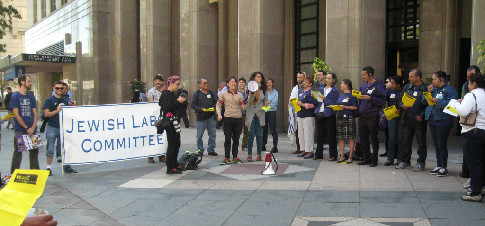
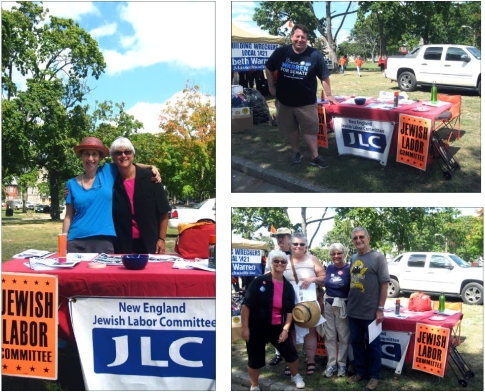
This year, the New England Jewish Labor Committee is coordinating "˜Labor on the Bimah' outreach in the greater Boston area to raise awareness in Jewish congregations of issues facing working families. In celebration of Labor Day, nine representatives, including union leaders, union members, attorneys, and a rabbi, will speak at synagogues in the greater Boston area about their involvement in support of workers. Speakers will discuss connections linking Jewish values and the fight for better treatment of working men and women. [Details below.]
One of the Boston-area synagogues participating in `Labor on the Bimah' is Temple Aliyah in Needham, where Martin Abramowitz, former VP of planning at Combined Jewish Philanthropies of Greater Boston, will give a D'var Torah. "For me as a volunteer, it's partly about being true to my roots (both my parents were union workers in the clothing industry)" Abramowitz said, "but it's mostly about recognizing that, in the end, 'we are all workers' and we need to regain our empathy with working people who are struggling. In the end, it's not about unions, but about workers."
Rabbi Carl Perkins of Temple Aliyah also thinks "˜Labor on the Bimah' is a worthwhile program. "During the week of Labor Day, when we read from the Book of Deuteronomy -- which goes out of its way to exhort us to care for those of limited economic means and which charges us to treat laborers with particular care and respect -- it behooves us to reflect on the challenges laborers face today and to try to bring the messages of our tradition close to home," he stated. "We need to ask ourselves what responsibilities the Torah would impose on us regarding laborers."
Fitting in with the secular calendar of Labor Day, the parsha of Shabbat on Labor Day weekend this year was Ki Teitzei, which has much to say about workers and our treatment of them. In Deuteronomy, Chapter 24, Verses 14-15 it says, "Do not take advantage of a hired worker who is poor and needy, whether that worker is a fellow Israelite or a foreigner residing in one of your towns. Pay them their wages each day before sunset, because they are poor and are counting on it. Otherwise they may cry to the Lord against you, and you will be guilty of sin."
Don Siegel, attorney at Segal Roitman and former Boston JCRC President, spoke about those verses in his D'var Torah at the Newton Minyan on the Shabbat before Labor Day. He commented that "just as the children of Israel needed to be reminded about their responsibilities to all workers before entering the promised land, Ki Teitzei reminds us all that those responsibilities haven't changed over time."
In addition to Siegel's d'var, nine other synagogues are participating in 'Labor on the Bimah' this year. This past Shabbat, Brian Lang, President of Unite Here Local 26, and Rabbi Barbara Penzner spoke at Temple Hillel B'nai Torah. Marya Axner, Regional Director of the New England Jewish Labor Committee, spoke at Congregation Dorshei Tzedek.
On September 8th, Martin Abramowitz will speak at Temple Aliyah; on September 15th Nicole Dector of Segal Roitman will speak at Temple Beth Zion, on October 12th; Dave Borrus of Piledrivers Local 56 will speak at Beth El Temple Center; and on Yom Kippur Dick Bauer, attorney at Greater Boston Legal Services, will speak at Kahal B'raira in Cambridge. [The author of this article, Stephanie Ainbinder, a former Jewish Organizing Initiative Fellow at New England JLC who is currently working for the Massachusetts Building Trades Council, will be speaking at Moishe Kavod House at a date to be determined.]
The Jewish Labor Committee has been working with congregations across the country for many years to focus on workers' rights during a Shabbat near Labor Day. And for over a decade, 'Labor on the Bimah' has been part of a nationwide effort to expand the way congregants think about their religion, justice, and workers' rights. Community leaders across the country speak at houses of worship as a part of a larger program, 'Labor in the Pulpit,' with specific outreach aimed at Jewish, Christian and Muslim congregations.
Marya Axner said that "we are looking forward to making "˜Labor on the Bimah' a yearly tradition in the Greater Boston Jewish community. We are committed to involving more synagogues, temples and havurot in our work over the next several years."