by Michael Hersch
A central theme of the story of the Jewish people is liberation from slavery -- the experience of being held against one's will, forced to work in dehumanizing conditions, with no compensation for labor.
And, in many ways, history repeated itself when waves of Jewish immigrants arrived in the United States in the late 1800s.
Many found work in garment factories and workshops in large urban areas such as New York, Philadelphia, Chicago and elsewhere. The conditions there were deplorable and led to tragedies such as the Triangle Shirtwaist Factory fire, which took the lives of 146 workers on March 11, 1911.
Most of the victims were young women, and many of them were Jewish immigrants. Although it was a relatively modern workplace, it was unsafe, and the workers trying to join the International Ladies' Garment Workers' Union were not successful in an organizing drive two years earlier. Insufficient means of escape, a workplace higher than the tallest fire ladders of the day, a spark -- and it went up in flames.
Recounting the details of this story, and the way in which this tragedy served as a catalyst for the organized labor movement in the U.S., and Jewish workers' role in that movement, has practically become another Haggadah for progressive Jews.
And perhaps it is something that has been told so many times that we have become desensitized to it, much in the same way our peoples' time in bondage in Egypt feels more like "just a story," rather than lived experience that we carry in our collective DNA. "Remember you were once slaves in Egypt" could be replaced with "Remember you were once poor immigrants working in dangerous sweatshops with no rights."
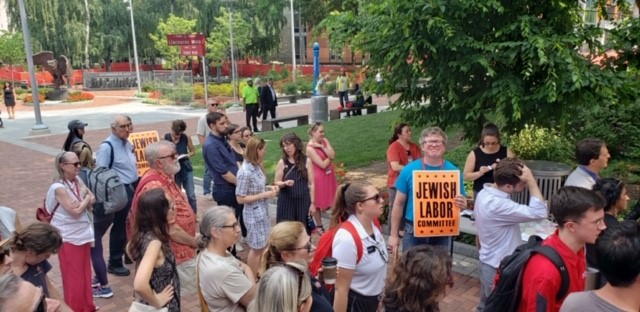
Philadelphia JLC activists rallied alongside TAUP - Temple Association of University Professionals, outside of a meeting of Temple University's Board of Trustees on July 9, 2019.
The lesser-known piece of the story of Jews' role in the first days of organized labor in the U.S. is that, by several accounts, the Jewish workers were difficult to organize, and organizing campaigns tended to lose steam after a victory had been won, regardless of how many more injustices needed addressing. For labor organizers in the late 19th century, it was Moses and the unruly Israelites all over again.
As late as 1905, Abraham Bisno, deputy inspector of factories for the state of Illinois, suggested in a report on Chicago's men's clothing industry that "most of the [Jewish factory workers] do not believe themselves to be working men for life, nor do they think that they will leave as a heritage to their children the lot of a wage worker."
He turned out to be correct: This was indeed the story of economic mobility that played out in the American Jewish community for close to a century. However, now we see a whole new generation of Jewish activists who are passionately pursuing justice in our broken world. From immigrant rights to climate change to fair wages, young Jews are disproportionately over-represented relative to the general population in both the leadership and the rank-and-file of many social justice organizations.
While many young activist Jews may be passionate about economic justice and feel deeply rooted in the imperative to "repair the world," they are relatively detached from both the history of Jews in the labor movement, as well as the role that unions have played in securing living wages and workplace rights for well over a century. It is no coincidence that the interconnected income and wealth gap in the United States has been growing as union membership has been declining.
The union membership rate -- the percent of wage and salary workers who were members of unions --was 10.5% in 2018, totaling 14.7 million workers. In 1983, the first year for which comparable union data are available, the union membership rate was 20.1% and there were 17.7 million union workers.
But that trend is not driven by the hostility of workers toward unions -- in poll after poll, a majority of nonunion workers say they would like to join a union if they could -- but rather by hostility of some employers and state and local governments to fundamental workers' rights.
A number of state legislatures have decimated collective bargaining rights, and passed "right to work" laws, which make it difficult for unions to collect dues, and, indeed, to function.
As we approach Labor Day, we will refrain from trying to convert those not concerned with economic justice to our point of view. We will not invoke the countless times the Torah, the Talmud, and response make clear the requirement that workers be treated fairly.
Instead, we call on those who are already committed to challenging unjust economic structures to make support for organized labor a priority, as one of the most effective way to fight the systems that keep all-too-many working families barely able to survive, without economic security, decent working conditions or a measure of dignity at work.
Michael Hersch is the Director of the Philadelphia Jewish Labor Committee.