" /> Jewish Labor Committee: February 2019 Archives

« January 2019 | Main | June 2019 »

February 27, 2019

Kahanists: A Danger to Israelis and Israeli Democracy

The Jewish Labor Committee joins a range of Jewish communal organizations in condemning the unprincipled opportunism of Israel's Prime Minister in working to secure the participation of the far-right Otzma Yehudit party as part of the maneuverings leading up to the upcoming Israeli elections. Otzma Yehudit adheres to the racist policies of the late Meir Kahane. We specifically support the statement issued last week by eight kindred organizations -- Partners for Progressive Israel, Ameinu, Americans for Peace Now, J Street, the National Council of Jewish Women, the New Israel Fund, Reconstructing Judaism, and T'ruah: The Rabbinic Call for Human Rights -- and we join in their call on the American Jewish community to affirm that "Kahanists Have No Place In The Knesset."

Encouraged by additional statements from a range of groups within the United States as well as in Israel, we invite our members and friends to join us in this, and join with tens of thousands of Israelis who are working to keep Kahanists out of public life - by signing the online petition here: https://secure.nif.org/onlineactions/L2Bxc4DgMEGB0FwO7wLKDg2?ms=via_JLC

..........................................................................

February 22, 2019

This week, Prime Minister Benjamin Netanyahu, keen to shore up his electoral position, orchestrated the unification of the extreme right-wing party Otzma Yehudit ("Jewish Power") with the National Union so that it could enter the Knesset in a consolidated right-wing bloc. This is dangerous and deeply concerning. Otzma Yehudit is the latest iteration of a political party based on teachings of racist demagogue Meir Kahane.

For decades, the consensus in Israel was that these racist extremist organizations should have no place in the Knesset. We are outraged that right-wing political parties and their leadership have reversed course and opened the door for Kahanists to enter into the Israeli political mainstream.

Our organizations do not advocate for or against any candidate or party in any election. We stand together for the principles enshrined in Israel's Declaration of Independence. Kahanism, empowered in government, represents a clear and present danger to those values.

Kahane's party, Kach, was banned from the Knesset in 1988, was outlawed as a terrorist organization in Israel in 1994, and still appears on the US State Department list of Foreign Terrorist Organizations.

Modern day Kahanists are working to divide Israeli society by stoking racial fears. They seek to strip all non-Jewish Israelis of basic rights; many encourage violence toward Arabs and LGBTQ Israelis. These Jewish supremacist organizations often use incitement to violence to promote their racist agenda. That's why the US State Department, the EU and the Canadian government all list Kahanist organizations as terrorist groups.

Today's Kahanists have been convicted numerous times for support for terror organizations and incitement to racism. Michael Ben-Ari, a leader of Otzma Yehudit and candidate for Knesset, was denied a visa to enter the US due to the State Department's "prerogative to ban terrorists from entering the country."

As Americans, we have seen the devastating effects of elected officials embracing white nationalist groups. In America, deadly right-wing extremism poses a clear and present danger to our democratic society. In Israel, it is Kahanists -- and the political mainstream that embraces them -- that pose the most direct threat to Israel's democratic fiber.

We call on our colleagues in the American Jewish community and Jewish organizations to stand for democracy and equality and join us in affirming that Kahanists have no place in the Knesset.
February 14, 2019

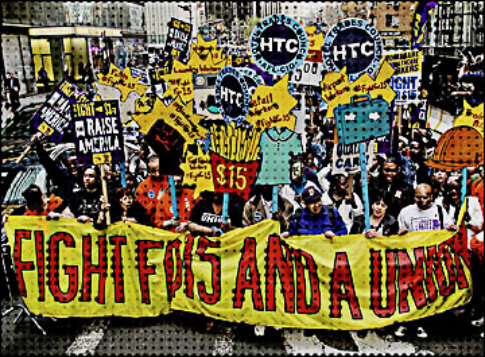
National Jewish Umbrella Agency Calls for Increasing the Minimum Wage to $15 / Hour

FF15 iMAGE.jpg

February 11, 2019: Washington, DC -- The Jewish Labor Committee (JLC) has secured the explicit endorsement for the Federal Minimum Wage to be raised to $15/hour from the Jewish Council for Public Affairs, at the JCPA's annual conference recently held in Washington, DC. The Jewish Labor Committee is a founding member organization of the JCPA.

The resolution - text below - updated a 2014 resolution that supported an increase in the Federal Minimum Wage to $10.10/hour.

The Jewish Labor Committee prepared the updated resolution, and submitted it with the co-sponsorship of a number of national and local Jewish agencies, including the National Council of Jewish Women, the Rabbinical Assembly (the international association of Conservative rabbis), the Reconstructionist Rabbinical Association, and the Union for Reform Judaism, plus four local bodies: the Community Relations Committee of the Jewish Federation of Nashville and Middle Tennessee, the Jewish Community Relations Council of Greater Boston, the Jewish Community Relations Council of the Jewish Federation of Silicon Valley (Los Gatos CA), and the Jewish Community Relations Council of the Milwaukee Jewish Federation. All are affiliated with the JCPA.

The four-day annual conference, which ran from Feb. 9th through Feb. 12th, drew some 250 professionals and volunteers from across the United States; sessions reflected the range of policy issues being dealt with at the national and local level. JCPA, the national hub of the Jewish community relations network, represents 125 local Jewish community relations councils (JCRCs) and 17 national Jewish agencies, including organizations representing all four major denominations of religious Judaism.

Resolution on Increasing the Minimum Wage

Jewish tradition repeatedly calls for social justice, demanding that we not only feed the hungry, but also help those in need become self-sufficient. The Torah repeatedly emphasizes the need to treat workers fairly. According to Deuteronomy 24:14-15, "You shall not abuse a needy and destitute laborer ... but you must pay him his wages on the same day, "¦ for he is needy and urgently depends on it"¦." The federal minimum wage, $7.25 since July, 2009, has failed to keep up with the cost of living. Had it kept up since 1968 when it was $1.60, in today's dollars it would now be close to $11.55 an hour. The federal minimum wage law was enacted in 1938 to establish a floor, below which wages would not go, but for too many workers the floor is also the ceiling.

Historically, minimum wage workers were more likely to be the less advantaged among us -- younger rather than older, female rather than male, African-American or Latino rather than white -- and that is still the case. Even though the current unemployment rate is low, workers of every age, gender and race find themselves working at jobs that only pay the minimum wage.

A single woman working full time at $7.25 per hour might manage to keep herself at or slightly above the poverty line, depending on where she lives, but she would fall below it if she had any dependent children. Many minimum wage jobs are part time and many low wage workers work several part-time jobs in an effort to feed, clothe and house themselves and their families. Many of these workers survive only because of a tax-supported increasingly frayed social safety net -- Supplemental Nutrition Assistance Program (SNAP) benefits, subsidized housing, the earned income tax credit and Medicaid. It is a disturbing development that many households with one or more full time workers are eligible for SNAP benefits or housing because wages are too low.

Most minimum wage jobs are in service industries and, as the economic recovery has lagged, most of the job growth has been in the service sector. These are workers in the food service, leisure and hospitality, and health industries. They work in restaurants, hotels, nursing homes, hospitals, and retail.

A proposed increase in the minimum wage to $15/hour would raise the wages of about 41 million workers. More than half of the workers who would benefit are adults between the ages of 25 and 54, and nearly two-thirds work full time. More than half (56 percent) are working women, and nearly 30 percent have children. Their pay increase would provide needed economic stimulus, increase gross domestic product and create new jobs.

The failure of the Congress to pass legislation raising the minimum wage has led many to advocate for legislation raising the wage at the state and local levels. This will benefit some workers, but it is no substitute for comprehensive national legislation.

The Jewish Council for Public Affairs believes:

* A wage earner working full time should be able to provide a minimum level of support for him/herself and his/her family;
* Federal legislation should set a floor, commonly agreed to approach $15/hour;
* The failure to require a minimum wage which keeps workers out of poverty subsidizes low wage employers at the expense of society;
* The need for safety net programs such as SNAP, affordable housing, the Earned Income Tax Credit, and Medicaid would be lessened if the minimum wage were raised to an adequate level.

The Jewish community relations field should:

* Educate about the failure of the minimum wage to keep pace with the cost of living;
* Educate about the fact that the minimum wage is too low to keep workers and their families out of poverty;
* Advocate for legislation increasing the federal minimum wage to at least $15/hour by 2024, and thereafter annually indexing the minimum wage with an appropriate Bureau of Labor Statistics' cost of living index, increasing the minimum wage for tipped workers by $0.90 per year until it reaches 70% of the non-tipped wage, and then indexing it so that it remains at 70%;
* Advocate for increases in the minimum wage at the state and local levels;
* Encourage Jewish organizations to institute a $15/hour minimum wage policy for all of their employees and contractors' employees.