" /> Jewish Labor Committee: March 2016 Archives

« February 2016 | Main | April 2016 »

March 23, 2016

Triangle Shirtwaist Fire And Its Relevance 105 Years Later
Triangle_Fire_2016.jpg

105 Year Later, We Will Not Forget!
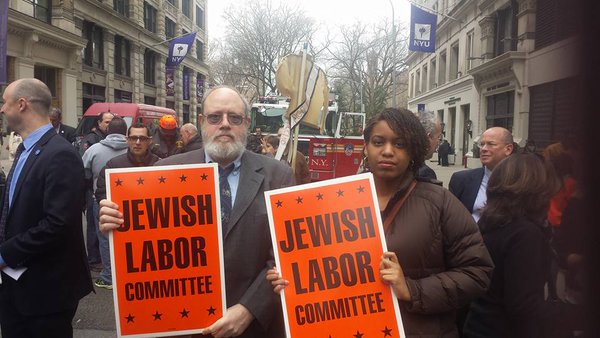
(l-r Arieh Lebowitz, Associate Director, and Brittney Willis, Intern. Photograph by Avia Moore.)

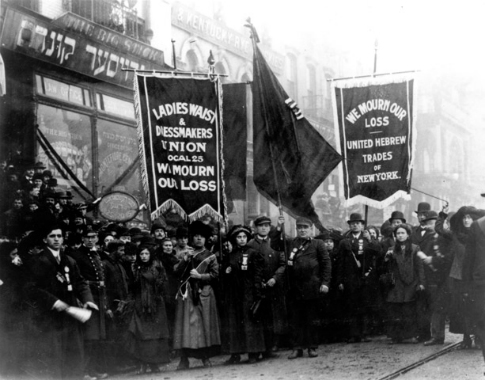
March 23, 2016: New York, NY -- One hundred and five years ago, March 25th, 1911, was a tragic day in New York City. 146 women and girls, mostly Jewish and Italian immigrants, perished from a fire that spread on the floor where they worked making shirtwaists, ladies' blouses. On the 8th, 9th, and 10th floor of a building between Washington Place and Greene Street, just east of Washington Square Park, these poor souls could not escape the Triangle Shirtwaist Factory workplace: the locks on the door that were originally placed to protect minor property loss lead to a horrific loss of lives. Not long after the Triangle Shirtwaist Fire, the United Hebrew Trades of New York, the Ladies Waist and Dressmakers Union Local 25 of the International Ladies' Garment Workers' Union, the ILGWU as a whole and others held a funeral procession (see above) to mourn the loss of the garment workers' lives.

105 years later, the United Hebrew Trades, now the New York Division of the Jewish Labor Committee, still commemorates not only the loss of workers' lives on the job, but the need to protect the safety of workers, and their right to join a union. On March 23rd, 2016 the Jewish Labor Committee joined with others to again commemorate the Triangle Shirtwaist Factory Fire (picture below). The deaths of these garment workers were not totally in vain: as a result of this tragedy, more than 36 laws were passed for improved fire and safety laws, as well as child labor laws.

We cannot afford to forget this tragedy. It helped secure many of the labor rights that we have in the United States today. The deaths of 146 women and girls were not necessary for the fight better working conditions. But this tragedy exposed many of the ills industrial greed causes. Over 100 years later, there is still much work to be done to combat poor factory conditions across the globe. Factory fires, unsafe working conditions, excessively long work days, poverty-level wages, exploitation of children as workers still plague countries like Bangladesh, Vietnam, China, Mexico, Russia, Philippines (and elsewhere). There are still sweatshops, factories, fields and several other places with labor violations in the U.S. in 2016!

Until the day that corporate and industrial greed no longer causes the suffering of factory workers, we will continue to commemorate the 146 victims of the Triangle Shirtwaist Factory fire who paid the ultimate price.
Triangle_Fire_1911.jpg

March 22, 2016

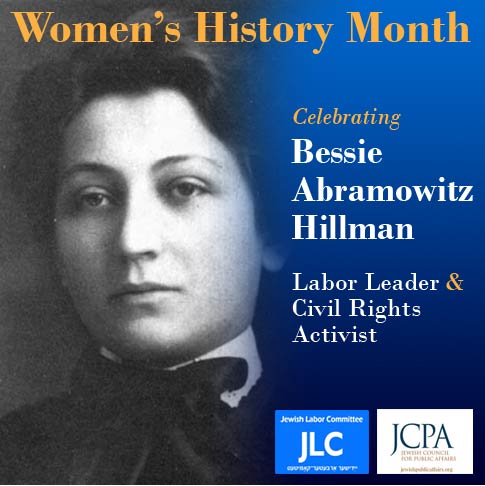
Celebrating Bessie Abramowitz Hillman

Bessie_Abramowitz_Hillman_Graphic.jpg

March 22, 2016 - This Women's History Month, the Jewish Labor Committee and the Jewish Council for Public Affairs are celebrating the life and achievements of a woman who made great contributions to both workers' rights and civil rights, Bessie Abramowitz. She was a fighter for worker's rights the moment she started working her first factory job in the garment industry, back in the early 1900s.

Bas Sheva Abramowitz was born May 15th, 1887 in a small village, Linoveh, near the Grodno, a city in Russia. She grew up in a family of 10 children and spoke only Yiddish and Russian. At the age of eighteen, she made the decision to emigrate with an older cousin to the United States to avoid the fate of many her age, arranged marriage. And so, in 1905, she moved to the United States, and lived in Chicago, in a boardinghouse owned by distant relatives. Her first job was sewing buttons at a Hart, Shaffner, and Marx garment factory. During the day she worked and at night she was enrolled in the Hull House night school; she became a naturalized U.S. citizen in 1913.

Abramowitz's first job did not last long: in 1908, shortly after she organized a shop committee to protest working conditions and pay of three dollars for a sixty-hour week, she was fired. This incident led her to be blacklisted as a labor agitator. She eventually again found work at Hart, Shaffner, and Marx using a pseudonym. But being blacklisted would not stop her on her quest for decent working conditions and better pay.

On September 22, 1910, she formed a walkout with 16 other employees to protest a cut in the piece rate. The walkout quickly gained support. By October, around 8,000 factory workers had joined the strike, including future labor leader - and future husband - Sidney Hillman. The strike eventually gained support of Jane Addams of Hull House and the Women's Trade Union League, and Abramowitz was hired as a WTUL organizer.

The success of the strike she organized led her to gain other roles in the labor movement, including in the newly-formed Amalgamated Clothing Workers of America. In 1915, Abramowitz was elected to the general executive board of the ACWA. She continued her organizing efforts well beyond Chicago, organizing workers in Pennsylvania, upstate New York, Ohio, Connecticut, and elsewhere. Her organizing also led to her being involved in civil rights when she became the education director of ACWA's Laundry Workers Joint Board in 1937. At the Laundry Workers, her work with many nonwhite workers that inspired her to become involved in civil rights.

When World War II broke out, Abramowitz became director of Amalgamated's War Activities Department, supervising a massive blood drive as well as savings bond sales and clothing and scrap collection drives. She and her husband became involved in the fight against Nazi Germany's attempt to wipe out the Jewish people

Through their help with the union's war efforts they were able to form strong political and labor bonds with President Franklin D. Roosevelt. This in turn led to Abramowitz's being named by New York Governor Herbert H. Lehman to the advisory board of the New York Office of Price Administration. She protested vigorously against the Nazis, among whose victims were some of her closest family members. In 1947, she traveled to Europe on a union-sponsored mission to help with the massive crisis of displaced persons in the immediate post-Holocaust years.

In a political career lasting many decades, Bessie Abramowitz Hillman served with many organizations to continue the fight for both workers rights and civil rights, including the civil rights committees of the Congress of Industrial Organizations, and the AFL-CIO, the CIO Community Services Committee, the National Consumers League, the American Labor Education Service, Inc., the Committee on Protective Labor Legislation, the American Association for the United Nations, and more.

She remained passionate and active in labor activities, for the rest of her life. "Bessie" passed away on December 23rd 1970. Her courage and activism as a strong, progressive, secular American Jewish woman is a precious legacy that still lives on today

March 18, 2016

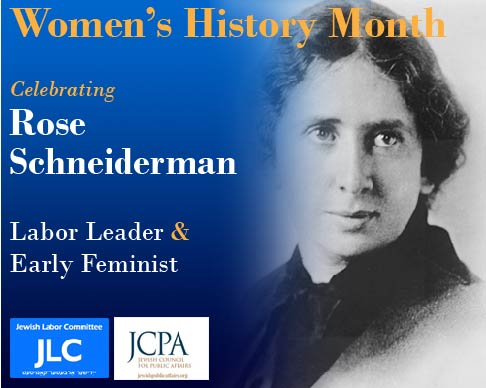
Celebrating Rose Schneiderman

Rose_Schneiderman_WHM_Post.jpg

March 18, 2016 - In honor of Women's History Month the Jewish Labor Committee and the Jewish Council for Public Affairs celebrate a great unsung contributor to both women's and workers' rights, Rose Schneiderman, a dedicated activist who spent her life fighting for things many of us too often take for granted, such as the eight hour work day, a federal minimum wage, workplace safety, and more.

Rachel Rose Schneiderman started from humble background. She was born on April 6, 1882, as the first of four children of a religious Jewish family in Savin, Poland. She immigrated to America with her family when she was a young girl. Shortly after her father passed away, she was forced to stop attending school when she was nine years old in order to take care of her brothers. When poverty forced her mother to place her siblings into an orphanage, she was able to return to school for a brief period until her mother lost her night job as a seamstress. Rose had to drop out of school at thirteen years of age to work as a retail salesgirl. She never got the chance to complete a formal education, but that didn't stop her from self educating and becoming an avid reader.

Schneiderman worked as a salesgirl on New York's lower east side for three years, but she wasn't able to make ends meets. She then picked up a factory job as a cap maker. Although the pay was slightly higher, she was appalled by the treatment of women garment workers and the blatant gender hierarchy. It was at this job where her career in activism blossomed. In 1903, she successfully organized fellow women workers of the company to join the United Cloth and Cap Makers, and championed getting women elected in the union. By 1904, she was elected to the union's executive board.

For the next couple of years, she continued to fight for women's rights and worker's rights, especially for immigrant Jewish women who were often underrepresented within the labor movement's leadership. Schneiderman was active as a union organizer in the years leading to the "Uprising of the 20,000" of New York's shirtwaist makers in 1909"“1910, which was called the largest strike by American women workers up to that point. Schneiderman helped form and was active in many organizations in her career, such as the New York Women's Trade Union League (NYWTUL) (Vice President in 1906, she was its President from 1917 to 1949), the International Ladies' Garment Workers' Union (ILGWU), and the National Women's Trade Union League (WTUL) (President of the WTUL from 1926 until it disbanded in 1955.

Throughout her years as an activist, she organized many Jewish immigrant women and other women to strike against garment factories to secure better working conditions. Schneiderman also championed women's suffrage and helped establish the first suffrage organization composed primarily of industrial workers, the "Wage Earner's League for Woman Suffrage" in 1922 Her activism eventually led her to be the only woman appointed by President Franklin D. Roosevelt to be on the National Labor Advisory Board in 1933. Then, in 1937, she became the New York State Department of Labor's secretary.

Rose Schneiderman laid the groundwork for women and labor rights for today. Her work will forever be worth celebrating as a great Jewish woman and activist.