Israeli President Peres receives Congressional Gold Medal
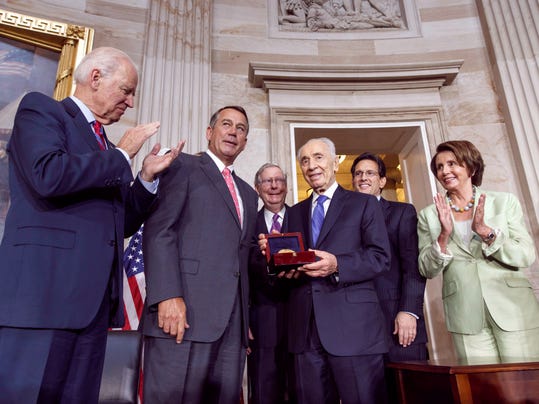
Israeli President Shimon Peres, center, at Congressional Gold Medal ceremony on Capitol Hill in Washington, DC (Photo by J. Scott Applewhite, AP, in the Citizen-Times)
June 26, 2014: Washington, DC -- Israeli President Shimon Peres received the Congressional Gold Medal today in an audience, which included Jewish Labor Committee Acting Executive Director Rita Freedman, filling the Capitol Rotunda.
After a career in public service that began before the State of Israel was founded, the 90-year old will be leaving the presidency in a matter of a few weeks. But he does not intend to give up his quest for peace. The speakers lauding him were Vice President Joe Biden, Speaker of the House of Representatives John Boehner, House Democratic Leader Nancy Pelosi, House Majority Leader Eric Cantor, Senate Majority Leader Harry Reid, Republican Senate Leader Mitch McConnell, Congressman Joseph Kennedy III and Senator Kelly Ayotte.
Speaker after speaker recounted how Peres went from being a soldier to a peacemaker, a politician to a statesman, who helped ensure Israel's security and was as indefatigable in his quest for peace, who held almost every official position in Israel, and who worked for justice not only in his home country but throughout the world.
Peres thanked President Obama for standing with Israel, and to the U.S Congress for its unwavering and generous support of Israel. He talked about the challenges we face together: the fight against terrorism and the fight for peace. Security and prosperity are no longer national issues, they are global and must be worked for globally, he explained. And so, together, we must work against terrorism and poverty, fight not only the acts of terror, but also the roots of terror. Religions can play a meaningful role in combating terrorism and restoring hope, and ensuring that terrorism does not high jack faith, he noted.
In the Middle East, he acknowledged, "it is easy to sink into despair," but, he said, he has seen too much in his lifetime and the lifetime of Israel to lose hope. His dream is that the Middle East become a start-up region, just as Israel has become a start-up nation. But to do this, these countries must open up, because without openness and free thinking, there is no new thinking. Two-thirds of the people in the Middle East are under the age of 25, and in this, Peres sees a source of hope, for these young people want free and open expression. The U.S. and Israel have a unique opportunity to offer our values and our dreams and together, put the region on a better course.
Peres said that we must prevent Iran from securing a nuclear weapons capability, and that Iran should be judged by its actions, not its words. On behalf of the parents of the three Israeli boys who have been kidnapped, he asked that we all engage in the effort to return them to their families. And he expressed his belief that there is no better solution than a two-state solution: a Jewish state, Israel and an Arab state, Palestine. Peres reiterated his position that Palestinian Authority President Abbas is clearly a partner for peace, a view he said not everyone agreed with, but more are coming to that view. Abbas spoke bravely in Saudi Arabia and in Arabic against the kidnapping of the three youths and against terrorism, but Hamas, Peres said, is clearly not a partner for peace since it supports terror.
Peres ended by saying that he has lived long enough to see the impossible become possible, and that peace is the most possible impossibility, and offered one piece of advice to the United States: "Don't dream small. You are great. So dream big. And work to will those dreams into a new reality for you and all humanity."