" /> Jewish Labor Committee: August 2013 Archives

« July 2013 | Main | September 2013 »

August 28, 2013

Justice means raising NJ's minimum wage

by Rita Freedman and Arieh Lebowitz
New Jersey Jewish News - August 28, 2013

This November, New Jerseyans have the opportunity to support the economic fortunes of more than 400,000 residents who work for the lowest wages in the state. There is a constitutional amendment on the ballot to increase the minimum wage in New Jersey from $7.25 to $8.25 an hour, which also provides an annual cost-of-living adjustment to ensure the minimum wage keeps pace with the cost of basic necessities. The last time the legislature voted to raise the minimum wage was 2005. The minimum wage has simply not kept pace with the cost of living in New Jersey.

The Jewish communities of New Jersey -- and indeed across the United States -- remember full well the situation confronting so many of our ancestors as they came to this country: the prospects of low wages and hard jobs in the garment trades and other sectors. All of us should remember the difficulties of making ends meet with poor wages, tough economies, and the effort that went into not only getting by but trying to assure a better life for one's children.

The challenges confronting those who earn the minimum wage today are no less daunting. More than 400,000 hardworking New Jersey men and women of every race, creed, and faith earn the minimum wage, which is lower than those of 19 other states and the District of Columbia, despite the fact that the Garden State's cost of living is about 30 percent higher than the national average. They are the workers who care for our elderly parents, pump our gas, pick our produce, clean our offices, and wash dishes at restaurants. The vast majority of them work multiple minimum wage jobs to support their families; they are still struggling. They are faced with terrible choices, such as which bills to pay every month, choices about rent or heat or groceries or medicine that none among us should be forced to make.
RaiseNJsMinWage.jpg

Poll after poll has shown overwhelming support for raising the minimum wage. A recent Rutgers-Eagleton study found that 77 percent of voters support the amendment, while just 18 percent oppose it. But passing the amendment still won't be easy because business groups have launched a $500,000 ad campaign to try to convince the public that a higher minimum wage is bad for New Jersey.

Detractors say that raising the minimum wage costs jobs. That is simply not true. According to New Jersey Policy Perspective, a non-partisan, non-profit research group, raising the minimum wage would inject more than $276 million into the economy. Workers earning the minimum wage are the most likely group to spend that additional money on household items. The resulting consumer spending would result in an overall increase in the Gross Domestic Product of more than $174 million in 2014. Most of it will be felt in New Jersey.

Detractors also claim that most minimum-wage workers are teenagers or people working for pocket money. That, too, is simply not true: Many are working adults with families to support. New Jersey Policy Perspective found that 77 percent of the people directly affected and 89 percent of those indirectly affected by a minimum wage increase are 20 and older. Moreover, 59 percent of those who would benefit are women -- and 38 percent have attended or graduated from college.

Raising the minimum wage in New Jersey by voting "Yes" -- on the "New Jersey Minimum Wage Increase Amendment, Public Question 2," on the November 5, 2013 ballot in the state of New Jersey -- is the just thing to do. In Parshat Shoftim, read earlier this month, the Torah proclaims, "Justice, justice shall you pursue." If we are to provide a measure of justice where it counts to the least-well-paid among us, we have to all do our part to ensure passage of this important ballot measure on Nov. 5.

We must partner together with others across the Garden State to ensure that this is approved by the voters. This will only happen if we talk about it with our friends, families, and neighbors to ensure passage. We in the Jewish Labor Committee are proud to support the "Raise the Wage" campaign, and encourage people to learn more and sign up to participate in this important campaign at www.raisethewagenj.org.

It's the right and just thing to do.

Rita Freedman and Arieh Lebowitz are the Acting Executive Director and Associate Director, respectively, of the Jewish Labor Committee. This article was also published by Teaneck's Jewish Standard, and the Cherry Hill's Jewish Community Voice.
August 27, 2013

Join the Campaign to Raise the Federal Minimum Wage!

by Stuart Appelbaum
President, Jewish Labor Committee

It's not that often that Labor Day and Rosh Hashanah fall so close together on the calendar. This year they are but three days apart, providing an opportunity for some introspection on an issue that should be of concern to the entire American Jewish community: the pitiful state of the federal minimum wage.

The federal minimum wage isn't a living wage. At $7.25 an hour, today's full-time minimum-wage worker makes just $15,080 a year. Even in a family with two people working minimum-wage jobs, household income hovers at the poverty level. And that's assuming they are lucky enough to have full-time jobs.

Moreover, the makeup of minimum-wage workers has changed. James Surowiecki, writing in The New Yorker on August 12th, noted a recent study by the economists John Schmitt and Janelle Jones showing that "low-wage workers are older and better educated than ever."

"More important," Surowiecki wrote, "more of them are relying on their paychecks not for pin money or to pay for Friday-night dates but, rather, to support families."

Meanwhile, the purchasing power of the minimum wage has plummeted.

From January 1981 to April 1990, the federal minimum wage was never raised. In 2007, Congress raised the federal minimum wage by $2.10, to $7.25 per hour, as a first step toward restoring it to its historic value. But for the minimum wage to have the same purchasing power it had back in 1968, it would have to be more than $10 per hour now.

American Jews should remember the situation confronting so many of our ancestors, who could earn only poverty wages in the garment trades and other sectors when they first arrived in the United States.

The challenges confronting those in minimum-wage jobs today are no less daunting. They are the workers who care for our elderly parents, wash our cars, pick our produce, clean our offices and work at fast-food restaurants. The vast majority work multiple minimum-wage jobs to support their families and they are still struggling, faced with terrible choices over which bills to pay -- rent or heat, groceries or medicine -- that none among us should be forced to make.

A comprehensive study by the Economic Policy Institute points out the benefits of raising the minimum wage. An increase to $10.10 by July 1, 2015 would raise the wages of about 30 million workers, who would receive more than $51 billion in additional wages over the phase-in period, increase gross domestic product by roughly $32.6 billion and create a net gain of 140,000 new jobs.

It would not, as many conservatives claim, kill jobs. Moreover, it would be an important first step in closing the widening income gap.

So we need to raise the federal minimum wage. Yet much of the business sector and its allies continue to stymie even modest attempts to lift minimum-wage workers out of poverty.

Why? Essentially because they can.

Two years ago, former Smith Barney director Desmond Lachman told The New York Times, "Corporations are taking huge advantage of the slack in the labor market -- they are in a very strong position and workers are in a very weak position. They are using that bargaining power to cut benefits and wages, and to shorten hours."

Of course, not all the blame for low-wage workers lies with the businesses that employ them. The consuming public also plays a role. Too often, we fail to make the link between low prices and widespread poverty.

Some states, frustrated by the inability of Congress to raise the federal minimum wage, have raised the minimum wage locally. But this needs to be done nationally -- and it needs to be done now.

In Parshat Shoftim, the Torah proclaims, "Justice, justice shall you pursue." If we are to provide a measure of justice where it counts to the least well-paid among us, we have to do our part to support an increase in the federal minimum wage. We must partner with others to ensure it happens. We need to talk about it with our friends, families and neighbors.

We in the Jewish Labor Committee are proud to be part of this campaign and encourage the wider community to join. It's the right and just thing to do.

August 23, 2013

On the 50th Anniversary of the March on Washington for Jobs and Freedom

by Stuart Appelbaum
President, Jewish Labor Committee

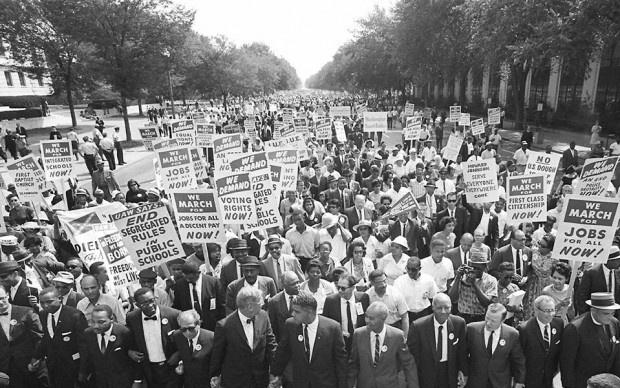
On August 28, 1963, more than 200,000 Americans gathered at the Lincoln Memorial in Washington, D.C., for a political rally known as the "March on Washington for Jobs and Freedom."

Under the leadership of A. Philip Randolph and with the civil rights leader Bayard Rustin as its principal organizer, this march, organized by a broad coalition of civil rights, labor, and religious groups, was one of the largest political demonstrations for human rights in the history of United States. It was designed to put the political, economic, and social discrimination suffered by African Americans squarely on the national agenda. The massive turnout, the dignity and discipline of its nonviolent plea for justice, and the grandeur of Martin Luther King, Jr.'s "I Have a Dream" speech made it a key moment in the long struggle for civil rights. Part of its legacy was passage of the Civil Rights Act of 1964 and the Voting Rights Act of 1965.

Of the many Jewish organizations that participated in the March, none brought more people to the event that day than the Jewish Labor Committee.

https://image.pbs.org/poster_images/assets/mlk.jpg
Image from The Unfinished Business of the March on Washington and the Civil Rights Movement Lesson Plan

From New York City alone, the JLC filled two railroad cars. From Philadelphia, a large contingent came in buses that were jointly chartered by the JLC and the Negro Trade Union Leadership Council. The two organizations had completely coordinated all of their March on Washington plans.

Other JLC groups came by cars, trains and planes from Baltimore, Boston, Pittsburgh, Detroit, Chicago, Minneapolis and the West Coast. All of the JLC's field officers were actively involved in promoting the March and worked with local March committees in their communities. JLC Executive director Emanuel "Manny" Muravchik, served as an advisor to civil rights activist and March coordinator, Bayard Rustin, and was instrumental in helping to mobilize the Jewish community. According to Rachelle Horowitz, who worked closely with Rustin to organize the March and was its transportation coordinator, Muravchik reached out to the leadership of major Jewish organizations to involve them in the March, and was Rustin's "eyes and ears" in the Jewish community.

The JLC's commitment to civil rights didn't begin in 1963. From the late 1940s, it had worked to set up "Committees to Combat Intolerance" in cities throughout the U.S. and Canada. It investigated labor practices in the South and protested employment discrimination in Northern cities as well. For many years it held annual civil rights conferences for labor activists. JLCers marched at Selma, Alabama and again in Memphis.

As people gather this month to honor the March on Washington at its 50th anniversary, it is particularly fitting that Bayard Rustin has just been named to receive the Presidential Medal of Freedom. And we recall with great pride the role the JLC played in this historic event, and the many contributions the JLC has made to combat manifestations of bigotry, prejudice and discrimination and to support civil rights legislation.
---
Stuart Appelbaum, President of the Jewish Labor Committee and President of the Retail, Wholesale and Department Store Union, UFCW.

Stay at Unionized Hotels and ...

... Protect Yourself with this Contract Clause!*

NEJLCatHyattdemoBostonJuly264web.jpg

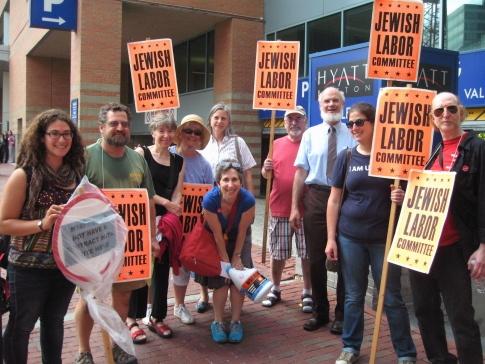
New England Jewish Labor Committee activists at a 200-person-strong rally in July 2012 at the Hyatt Regency Downtown (l-r: Sandra Korn, Dave Borrus. Martha Plotkin, Amy Mazur, Roberta Bauer, Marya Axner, Jim Marshall, Dick Bauer, Stephanie Ainbinder, and Glen Dansker)

(August 23, 2013) - In 2009, we learned that nearly 100 hotel workers at three Boston-area Hyatt properties were fired, only to be replaced by other housekeepers, who were paid less money, and whom the fired workers had actually trained in their work. Since then, we have been involved in support of not only the Boston-area Hyatt hotel workers who lost their jobs, but hotel workers in Hyatt properties across North America who have been working to secure decent working conditions and a measure of dignity on the job.

Based on our understanding of Jewish tradition that teaches us to be in solidarity with workers and not to profit from the products of exploited labor, the Jewish Labor Committee pledged not to hold events at Hyatt hotels where there are labor disputes. And when in July 2012 the hotel workers at Hyatt hotels across North America called for a global boycott of the overwhelming majority of these hotels, we not only joined in support of the boycott, but encouraged others to do so.

One year later, earlier this month, we were more than happy to learn news of an important development in the ongoing campaign to secure better working conditions for the hotel workers employed by the Hyatt Hotels Corporation. UNITE HERE, the union representing workers in the hospitality sector across North America, reached an agreement with Hyatt. The agreement, which will go into effect upon ratification of Hyatt union contracts in San Francisco, Hawaii, Chicago, and Los Angeles, sets forth a clear process for Hyatt workers at a number of hotels to secure union representation through a fair, mutually acceptable process, and creates a framework for an ongoing relationship between the union and the management of Hyatt. The contracts in the cities listed above would be inline with city standards in the industry, and include substantial wage increases, quality health and pension benefits, and job security. As part of the accord, upon ratification of the union contracts, UNITE HERE will end its global boycott of Hyatt.

It is clear, however, that this development would not have taken place without the steadfastness of these hotel workers, the concerted hard work of the labor movement, and the support of many in the community at large.

Many of you refused to book your events at Hyatt hotels. However, some of you could not because you had booked your event before the boycott was called and you would have suffered considerable financial penalties by canceling. It is typical to arrange hotel accommodations well in advance of events, and in the interim, a labor dispute could arise which may put you in the unfortunate position of crossing a picket line or incurring significant financial penalties.

*There are ways to avoid this situation. Continue reading to see this Contract Clause.

When you begin to consider holding an event at a hotel, it is really not hard at all to determine if the hotel is under boycott or if there is a risk of dispute. First step is to check with UNITE HERE, the hospitality workers union. Fortunately, they have prepared a website which has an extensive list of hotels to "Please Patronize," on one hand, and another list, "Boycott these Properties." Just look here: http://www.hotelworkersrising.org/HotelGuide/

Then, when you select a venue, you should have a clause -- it is called a "force majeure" clause -- included in your contract with any hotel; it will make it possible for you to cancel without penalty in the event of a labor dispute that arises after you sign your contract. Attached below, at the end of this letter, is a sample clause you can use and we strongly encourage you to do so. Have your own lawyer go over any contract, of course!

By organizing, these workers have been taking significant risks. They do so knowingly in order to ensure their livelihoods in the long term. We at the Jewish Labor Committee strongly urge you to stand with them by including protective language in your events contracts and honoring their boycotts. Again, sample text is attached, below, for your convenience.

If you have any questions, please do not hesitate to contact us.

Sincerely,

Rita Freedman, Acting Executive Director
Arieh Lebowitz, Associate Director

-----------------------------------------------------------
* ESCAPE CLAUSE IN CASE OF LABOR DISPUTES

NOTIFICATION OF LABOR DISPUTE

The Hotel agrees to notify the [NAME OF ORGANIZATION / CONGREGATION] in writing within ten (10) days after it becomes aware of any labor dispute involving the Hotel including, but not limited to, union picketing, the filing of an Unfair Labor Practice charge by a union, the expiration of a negotiated labor contract, an existing or impending strike or lockout, or any other matter which could reasonably be construed as a labor dispute.

EXCUSED NON-PERFORMANCE DUE TO LABOR DISPUTE

Notwithstanding anything in this Agreement to the contrary, if performance hereunder would foreseeably involve the [NAME] in or subject it to the effects of a boycott, strike, lockout, picketing, or other labor dispute and the [NAME] therefore withholds, delays, or cancels performance, it shall have no liability there from, provided that the [NAME] may not withhold, delay, or cancel performance based upon a labor dispute involving its own employees. In the event of a cancellation under this section, neither the [NAME] nor its members shall have any future obligation under this Agreement, and any deposits or other payments made to the Hotel by the [NAME] or its members to reserve rooms or other space for use, and/or for services to be provided, shall promptly be refunded to the [NAME] or its members.

For purposes of this clause, labor dispute shall be defined as any controversy concerning terms or conditions of employment, or concerning the association or representation of persons in negotiating, fixing, maintaining, changing, or seeking to arrange terms or conditions of employment, or concerning employment relations, or any other controversy arising out of the respective interests of employer and employee, regardless of whether or not the disputants stand in relation of employer and employee.

This clause shall supersede all other provisions of this Agreement and shall be construed and enforced in accordance with the laws of [THE STATE / COMMONWEALTH / DISTRICT WHERE YOU ARE LOCATED].

August 12, 2013

Jewish Labor Committee Endorses New Jersey's "Raise The Wage" Campaign

Urges Passage of Question to be on Ballots across Garden State on November 5th

August 12, 2013 -- The Jewish Labor Committee announced today that it has endorsed the campaign to ensure passage of the ballot measure on November 5th to raise New Jersey's minimum wage from $7.25 an hour to $8.25 an hour and provide an annual cost-of-living adjustment. Spearheading the campaign is Working Families United for New Jersey.

"Raising the minimum wage in New Jersey is the just thing to do" said Stuart Appelbaum, President of the Jewish Labor Committee. "On August 10th across the state, Jews read a key passage from the Torah, namely, `Justice Justice shall you pursue.' If we are to provide a measure of justice where it counts to the least-well paid among us, we have to all do our part to ensure passage of this important ballot measure on November 5th."

"We are proud to have the support of the Jewish Labor Committee," said Charles N. Hall, Jr., Chairman, Working Families United for New Jersey, Inc. "They are an important member of our coalition and they will play a vital role to ensure passage of the minimum wage ballot measure."

The last time the New Jersey Legislature authorized a raise in the minimum wage was 2005, and it was phased in over two years. The minimum wage went from $5.15 to $6.15 and then from $6.15 to $7.15. It increased in 2010 from $7.15 to $7.25 to comply with the increase in the federal minimum wage. Despite having a cost of living 30 percent higher than the national average, New Jersey's minimum wage is among the lowest in the country.

After the Governor vetoed legislation that would increase the minimum wage and provide for an annual cost of living adjustment, the legislature authorized the measure to be placed on the November ballot for voters to decide. Ten states have their minimum wage tied to an annual cost-of-living increase, without a negative impact on their economy or having to wait for their state legislature and governor to finally approve another increase after hard working Americans have not been able to make ends meet for too long.

"We're reaching out to the Jewish community, the labor movement, and the community-at-large to support this much needed measure," noted JLC President Appelbaum. "It's in the interest of the vast majority of those who live and work in New Jersey to see that it is passed on November 5, 2013."