" /> Jewish Labor Committee: July 2013 Archives

« June 2013 | Main | August 2013 »

July 26, 2013

JLC President Appelbaum Signs onto Letter to PM Netanyahu;

Supports Decision to Participate in Kerry Peace Initiative

June 25, 2013: New York, NY - As part of the Jewish Labor Committee's support for the Kerry Peace Initiative to re-start negotiations between the Israelis and the Palestinians, JLC President Stuart Appelbaum signed onto a community letter to Israeli PM Benjamin Netanyahu. The letter, a project of the Israel Policy Forum, has received wide media coverage.
See the Al-Monitor's "American Jewry Embraces Netanyahu's Decision on Peace Talks," for instance. The Forward published the Jewish Telegraphic Agency's "140 U.S. Jewish Leaders Sign Letter of Support for Talks"; The Times of Israel had "US Jews lend support to peace talks in new letter"; The Washington Post's On Faith blog published the Religion News Service's "Prominent American Jews embrace Kerry peace talks."

Please see letter below; the letter, including the signatories, is online here and as a PDF here.

http://gdb.voanews.com/57CA471A-8873-4138-93FB-DF2B8F9329B0_mw1024_n_s.jpg

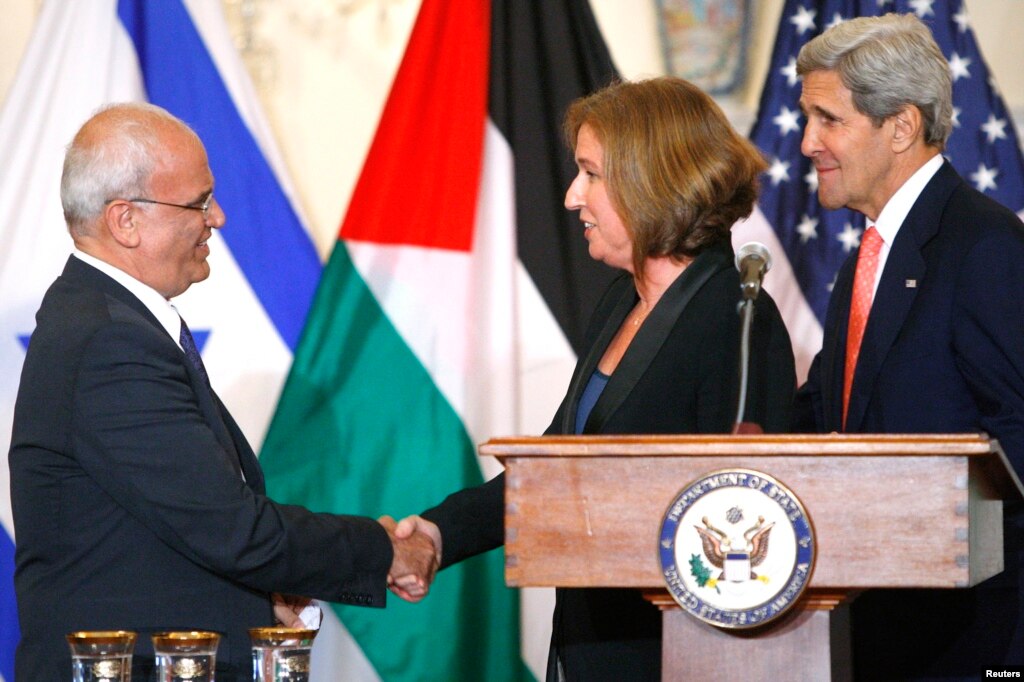
l-r: Palestinian chief negotiator Saeb Erekat, Israeli Justice Minister and chief negotiator Tzipi Livni, and U.S. Secretary of State John Kerry after the resumption of Israeli-Palestinian peace talks, Tuesday, July 30, 2013, at the State Department in Washington.

Dear Prime Minister Netanyahu:

We write to express our full-fledged support for your resumption of the diplomatic process with the Palestinians. As you have stated repeatedly, "peace can only be achieved through negotiations," and not through international campaigns that seek to isolate or delegitimize the Jewish state.

We recognize that achieving a two-state solution will require a territorial compromise that provides for a Palestinian state without jeopardizing Israel's security. That is why we applaud your understanding that one must be "willing to make painful compromises to achieve this historic peace." It is our hope that President Mahmoud Abbas will be similarly prepared to make the difficult decisions that achieving an agreement will require.

We share your concern that "the creation of a bi-national state between the Mediterranean Sea and the Jordan River "¦ would endanger the future of the Jewish state." We further agree with your statement that the resumption of peace talks is "important not only for ending the conflict with the Palestinians, but also significant in light of the Iranian threat and the civil war raging in Syria."

We are grateful for your leadership in embracing the process that Secretary Kerry has initiated, and offer our encouragement for you and the government of Israel as you embark on the challenging and delicate path ahead.

Sincerely,

July 19, 2013

Jewish Labor Committee Supports Kerry Peace Initiative, Opposes European Union's New Guidelines

June 19, 2013: New York, NY - Stuart Appelbaum, President of the Jewish Labor Committee, issued the following statement today:

With the tentative agreement that has just been announced, it appears that talks between the Israelis and the Palestinians may resume for the first time since 2010. The Jewish Labor Committee welcomes this progress and commends U.S. Secretary of State John Kerry for his commitment to bringing this about, as well as Israeli Prime Minister Benjamin Netanyahu and Palestinian Authority President Mahmoud Abbas to returning to the bargaining table. While clearly there are still differences, these can be resolved only if the two sides sit down together to negotiate.

One development that that could have undermined the tentative agreement, however, was the European Union's announcement that it will ban financing of and cooperation with Israeli institutions in the West Bank, the Gaza Strip, the Golan Heights and East Jerusalem. The new guidelines say that agreements providing research grants, scholarships and cultural exchanges must state explicitly that they apply only to Israel's pre-1967 borders.

The announcement, particularly coming at this delicate time, could have served to harden stances on both sides. Israelis reacted by reiterating their position that there should be no per-conditions for talks, and many feel that this constitutes undue economic and political pressure. Moreover, the pressure is only on one side, with none exerted on the Palestinians to return to the bargaining table, and in fact could have undermined efforts to convince them to negotiate.

We hope that both Israelis and Palestinians return to the bargaining table with a seriousness that includes a willingness to be flexible and to make fair compromises that lead to a two-state solution that benefits both the Israeli and Palestinian people.

July 16, 2013

Labor unions' Iranian opportunity and responsibility

Western workers' organizations must counter Tehran's hostility toward independent activists
By Stuart Appelbaum and Benjamin Weinthal / NEW YORK DAILY NEWS
Monday, July 15, 2013

http://www.workers-iran.org/images/osanlo_afshin.jpg
Afshin Osanloo, 42, jailed Iranian labor activist and political prisoner, who died in notorious Rajai-Shahr Prison in the city of Karaj. Photo via the International Alliance in Support of Workers in Iran.

On June 20, less than a week after the election of Iran's new president Hassan Rowhani, the 42-year-old Iranian trade unionist Afshin Osanloo died under mysterious circumstances in prison. Times are extremely tough for struggling independent labor activists in Iran.

Iran's notorious hanging judge, Abolqasem Salavati, sentenced Osanloo in 2010 to five years in prison for his effort to exercise employee rights in a country where independent unions and meaningful worker rights are non-existent. His tragic fate mirrors the death of the 35-year-old blogger Sattar Beheshti, who died while in police custody last November.

The court accused Osanloo of "collusion and assembly with the intent to act against national security." In other words, Iran's rulers raised bogus charges to criminalize democratic union activity.

Sohrab Soleimani, the head of Tehran Province Prisons, claimed Osanloo "died after a heart attack." But his sister, Fereshteh Osanloo, told the International Campaign for Human Rights in Iran that "my brother did not have any heart conditions. He was well. He exercised in prison every day. He had an in-person visit with my mother two weeks ago. My mother said that Afshin was healthy and doing well."

In an ominously written letter to international labor federations last August from prison, Osanloo captured the desperation and dogged optimism among working class Iranians. His appeal aimed to spark action from human rights groups and international organizations to stop Iran's violent crackdown on independent union organizing efforts.

"We want you [The International Transport Workers' Federation and International Labor Organization] to tell them how in our country we have no labor or human rights, and how unjust and illegal it all is and how the smallest complaint about our working conditions causes us to be severely tortured and imprisoned," wrote Osanloo.

The deceased truck driver Osanloo knew his subject matter from personal experience. Iran's security agents incarcerated him in the notorious Evin prison. "For five months I was kept in solitary confinement and was interrogated and tortured," wrote Osanloo in his prison letter.

The plight of Iranian political prisoners like Osanloo has not spurred major human rights action from the U.S. Instead, intense Western attention has been devoted to Rowhani, who hails from the inner circle of Iran's anti-Western supreme leader, Ayatollah Ali Khamenei, as a new president who can help the Iran engage the West.

The Islamic Republic's repression forced Mansour Osanloo, the brother of Afshin and viewed as "Iran's Lech Walesa," to flee Iran in May because of his independent union organizing activity. He sharply rejects the West's one-dimensional focus on Iran's nuclear weapons program at the expense of union and civil democracy promotion.

After all, Rowhani played a critical role in the violent suppression of Iranian student protests in 1999. Iranian students, like their counterparts in the pro-democracy union movement, sought to obtain democratic rights. Rowhani took pleasure in carrying out the regime order to "crush mercilessly and monumentally" the student demonstrations.

In short, Rowhani (former secretary of Iran's Supreme National Security Council for 16 years) has long been part of a brutal security apparatus that vehemently rejects the kind of economic and political democracy that Iranian trade unionists desire.

Rowhani's fundamentalist theocratic outlook will not move beyond the deeply embedded Islamic Labor Councils, which serve as a regime-controlled body to crackdown on independent union activity. Iran's anti-worker laws allow the supreme leader to appoint representative to sham worker organizations. According to an Iranian human rights group, "over the past three decades, the track record of Islamic Labor Councils and their central body, the Supreme Labor Council, has been in favor of management and its policies."

It is worth recalling that the U.S. labor movement took the international lead in the 1980s to aid the Polish shipyard worker Lech Walesa and the Solidarity movement to breath democratic life into communist-controlled unions. The result contributed to the dissolution of communism in Poland.

American labor unions are in a unique position to replicate the cold war Polish model of international solidarity. There is no shortage of pressure points to influence a change in Iran's behavior.

Western trade unions can symbolically adopt imprisoned Iranian labor activists as a way to spotlight the need for their release.

International trade union federations can issue resolutions condemning Iran. Human rights groups can ratchet up the pressure to show that Iran's violations of labor rights mean repression of human rights. That would be a start to fill the words of Afshin Osanloo's letter with meaning, content and action.

Stuart Appelbaum is president of the Retail, Wholesale and Department Store Union representing workers throughout United States. Benjamin Weinthal is a fellow with the Foundation for Defense of Democracies and member of the journalist's division of the German union Verdi.
A Petition to the Management of Walmart: Join Major Clothes Retailers in a Combined Worker Safety Agreement Now!

http://i2.cdn.turner.com/money/dam/assets/130424112019-bangladesh-factory-collapse-620xa.jpg

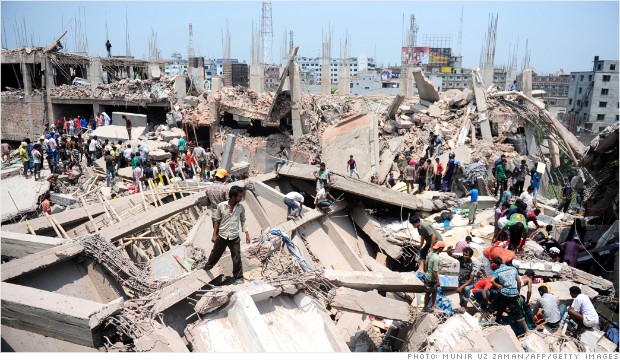
Photo: Munir Uz Zaman / AFP / Getty Images via CNN Money

Sign our petition calling on Walmart's management to join the international agreement to stop disasters like the Bangladesh tragedy. Just click here.

The world watched in horror as over 1,100 garment workers were killed in April when a substandard factory in Bangladesh collapsed while they were at their jobs. Similar tragedies are killing and injuring men and women in many places around the globe where labor costs are low and working conditions are unconscionable.

It took this building's collapse, following a disastrous fire in Bangladesh earlier this year, as it took the Triangle Shirtwaist Factory in New York over a century ago, to focus the attention of the world on addressing the need for better safety standards for those who make the clothes the world wears.

One important first step is an international agreement of major international retailers designed to stop such disasters from happening again. Already such well-known firms as H&M Hennes & Mauritz, Carrefour, Marks & Spencer, Inditex, PVH (which owns the Tommy Hilfiger brand), Loblaw (owner of Joe Fresh brand) have signed on to this accord, that provides for a binding, independent inspection program, mandatory improvements in workplace safety, and binding arbitration enforceable in the courts of the country where a company is based. Yet, Walmart is opting to do its own unenforceable audit of factory conditions, a type of self-auditing that has proved to be ineffective.

We're calling on the management of Walmart to join the international agreement of major retailers to commit to collectively stop such disasters from happening again. And we want you to join us.

Because so many of the world's garments are made by contractors and subcontractors, and retailers often do not track where and how products sold under their name are being made, it is imperative that there is a unified, enforceable agreement of all of the major retailers -- including Walmart -- to improve fire and building safety in such countries as Bangladesh, Cambodia, Vietnam, Pakistan and other countries where so much of our clothes are made.

Join us in calling on the management of Walmart to put basic principles of responsibility and decency to work by joining this international agreement -- now.

Sign our online petition here.

For more information about the situation confronting workers in Bangladesh, click here.

July 03, 2013

Chicago Teachers at Illinois Holocaust Museum

July2 _2013 Teachers at IL_Holocaust M4web.jpg
Photo by Abbey Romanek

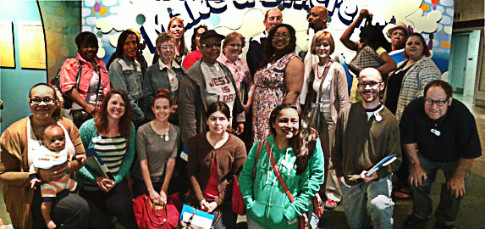
(July 2nd, 2013) Skokie, IL - Twenty-two teachers, members of the Chicago Teachers Union (CTU), took a special group tour today of the Illinois Holocaust Museum & Education Center in Skokie. Eli Fishman (right), Director of the Chicago Region of the Jewish Labor Committee, organizes these trips, working with the CTU Quest Center, which is looking forward to bringing even more teachers to such programs in the future. A number of teachers expressed their appreciation for the 'bullying' exhibit in the museum, part of the Museum's Anti-Bullying Initiative: the Museum has expanded its anti-bullying programming to include new resources and training for students, teachers, administrators and community organizations, such as its "Steps to Respect Bullying Prevention Program," which teaches elementary students to recognize, refuse, and report bullying; to be assertive; and to build friendships.