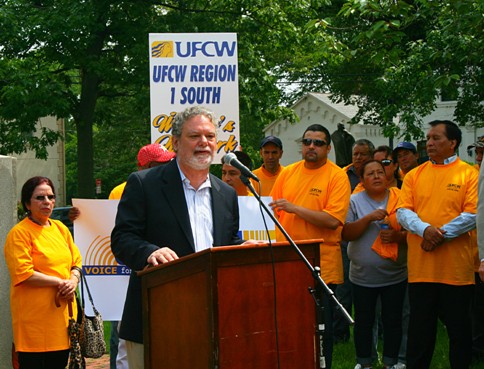
(May 6th, 2012) Detroit - The Jewish Labor Committee is pleased to report that a resolution in support of collective bargaining in the public sector was passed by an overwhelming majority of delegates to the annual conference of the Jewish Council for Public Affairs. The JCPA encompasses a network of 14 national and 125 local independent Jewish community relations agencies. The Jewish Labor Committee, a founding member of the JCPA, was one of the sponsors of the resolution, along with the National Council of Jewish Women, the Union for Reform Judaism, and the Jewish community relations councils of Boston, MA, and Silicon Valley, CA.
Martin Schwartz, Executive Director of the Jewish Labor Committee, noted that "while the JCPA had already supported the right of workers to join unions and engage in collective bargaining years ago, a strong statement at this time is important when the collective bargaining rights of workers, especially in the public sector, are under attack. We are deeply gratified that representatives of Jewish communities across the United States reaffirmed our traditional stand for fundamental workers' rights."
Complete text of the resolution follows:
Resolution on Collective Bargaining in the Public Sector
Both in spirit and in practice, religious commandments in the Torah and Talmud relating to the employment of workers are imbued with respect for labor rights. Jewish religious laws pre-date current secular labor laws by thousands of years. .
The American Jewish community has been supportive of worker and trade union rights for over a century. During the years of mass-immigration from the early 1880s to the second decade of the 20th Century, when American Jewry was a predominantly working-class community, the majority toiled in difficult and often desperate conditions in the garment industry and a range of other trades. The Jewish labor movement and the larger labor movement were essential to the success and advancement of American Jewry.
In recent years, there have been significant efforts to eliminate or substantially narrow collective bargaining rights throughout the United States at local, state and national levels. According to the National Conference of State Legislatures, in 2011 there was an eight-fold increase in the number of states seeking to restrict or eliminate collective bargaining rights of public workers. 550 bills involving public sector unions and employees, including teachers, police and firefighters have been introduced.
The right to collective bargaining in the United States is the law of the land for the private sector, based on the 1935 National Labor Relations Act. It protects the right of employees in the private sector to form and join unions and requires that employers bargain collectively with the union chosen by its employees. Collective bargaining is considered a universal human right under Article 23 of the United Nations Declaration of Human Rights.
Public sector collective bargaining entered into American law in 1959, when Wisconsin became the first state to protect public employees' collective bargaining rights. Today, almost all states require or permit collective bargaining. In 1962, President John F. Kennedy issued an executive order to grant many federal government employees the right to unionize and collectively bargain with departments and agencies. American Catholic Bishops, in response to the recent attacks on the collective bargaining rights of public servants, have declared official support for the "principles of justice" that these rights represent. "These are not just political conflicts or economic choices; they are moral choices with enormous human dimensions," stated Bishop Stephen E. Blaire of Stockton, California, chairman of the U.S. Conference of Catholic Bishops' Committee on Domestic Justice and Human Development.
The JCPA believes that:
· Collective bargaining plays a major role in reducing income inequalities.
· The right to collective bargaining in the public sector should be preserved or returned throughout the United States.
· Collective bargaining is a crucial way to improve the relationship between employees and employers, and promotes fairness and democracy in the workplace.
· Collective bargaining, by improving the wages and working conditions of public sector employees, has allowed public employers to attract and retain higher quality workers who provide better services to the public.
· Collective bargaining rights in the private and public sector are inextricably related so that weakening the rights in one has a negative effect on wage and benefit standards in the other as well.
· Focusing on unions and eliminating or diminishing public employee bargaining rights will not solve the complicated fiscal problems of governments. While collective bargaining does not guarantee outcomes, the absence of public unions does not ensure deficit reductions.
The community relations field should:
· Support collective bargaining, work in coalitions, and articulate Jewish perspectives in favor of collective bargaining by all employees, be they public or private.
· Vigorously work with members of Congress and members of state legislatures and local governments to resist all efforts (legislative, ballot initiatives, etc.) to undermine or eliminate the right of public employees to engage in collective bargaining.